


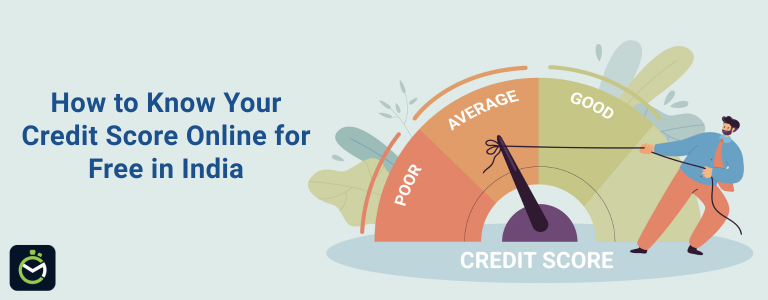
Your credit score plays an important role whenever you apply for a loan or credit card. Banks and financial institutions use this score to understand how responsibly you manage your credit and repayments. A positive credit history can help you qualify for better loan conditions and exclusive financial offers from lenders.
Today, checking your credit score has become simple and completely free. You can instantly know your credit score online using your PAN card, mobile number, or banking apps without affecting your credit rating.
Regularly monitoring your credit score helps you:
- Track your financial health
- Identify errors in your credit report
- Improve your loan eligibility
- Protect yourself from credit fraud
Before learning how to check your credit score, let’s first understand what a credit score actually means.
What Exactly Is a Credit Score?
A credit score is a three-digit number - ranging from 300 to 900 - that tells lenders how reliably you've managed borrowed money in the past. Think of it as your financial reputation, compressed into a single number.
In India, this score is calculated by four licensed credit bureaus:
- CIBIL (TransUnion) - the most widely used
- Equifax
- Experian
- CRIF High Mark
Each bureau uses slightly different algorithms, so your score may vary by 10–30 points across bureaus. That's normal. What matters most is the overall range your score falls in.
Here's a quick reference:
| Score Range | Rating | What It Means |
| 750 – 900 | Excellent | You're a lender's dream. Best rates, fast approvals. |
| 700 – 749 | Good | Strong profile. Most loans accessible. |
| 650 – 699 | Fair | Approval possible, but expect higher interest rates. |
| 600 – 649 | Poor | Limited options. Secured credit may help. |
| 300 – 599 | Very Poor | Most lenders will decline. Rebuilding needed. |
According to TransUnion CIBIL, approximately 79% of loans in India are given to borrowers with a CIBIL score of 750 or above. That one statistic shows just how much this number matters.
How to Check Your Credit Score for Free - 5 Real Methods
You don't need to pay anyone to know your credit score. Here are five reliable platforms to check your credit score at no cost.
1. Check Directly Through the Credit Bureaus
Each of India's four credit bureaus offers one free credit report per year under RBI guidelines.
CIBIL (most recommended for first-timers)
→ Visit TransUnion CIBIL Website
→ Click on "Get Your Free CIBIL Score & Report"
→ Register with your PAN card, date of birth, and mobile number
→ Verify via OTP
→ Your score and report appear instantly
Similarly, you can visit equifax.co.in, experian.in, and crifhighmark.com for reports from the other three bureaus.
Pro tip: Space out your bureau checks throughout the year. Check CIBIL in January, Experian in April, Equifax in July, and CRIF in October. This way, you get four free detailed reports annually instead of just one.
2. Check Through Your Bank's App or Net Banking
Many major Indian banks now offer free, ongoing credit score access - not just once a year - directly inside their apps. No separate registration needed.
- HDFC Bank - Credit score visible in the app under "Loans & Credit Cards"
- ICICI Bank - Available in iMobile Pay under your profile
- Axis Bank - Accessible via the Axis Mobile app
- SBI - Available through YONO app
- PNB - In the PNB ONE app
If your bank offers this, it's the most convenient option because it updates regularly and you're already logged in.
3. Use a Fintech Platform
Several third-party fintech platforms offer free credit score access, often with added features like score improvement tips, credit offers tailored to your profile, and alerts when your score changes.
Popular options include:
- CreditMantri (creditmantri.com) - Also shows personalized loan and credit card matches
- OneScore - Clean interface, detailed score breakdown, regular monitoring
- IndiaLends - Free score + loan comparison
- Paytm - Credit score visible inside the Paytm app
- BankBazaar - Free score with product recommendations
How to check on CreditMantri specifically:
1. Go to CreditMantri Website
2. Enter your mobile number and click "Get Started"
3. Enter the OTP sent to your phone
4. Your credit score and a list of matched credit offers will appear
These platforms do a soft inquiry, which means checking your score here will never lower it.
4. Claim Your Free Annual Credit Report
Beyond just the score, you're entitled to a full credit report (showing all accounts, payment history, enquiries, and more) for free once a year from each bureau.
This is different from just seeing your score, it's the full picture. Download it, read through it carefully, and look for anything that doesn't belong to you.
What Goes into Your Credit Score? The 5 Factors That Matter
Your score isn't random. It's calculated based on specific, predictable factors. Understanding them puts the power back in your hands.
1. Payment History - 35%
The biggest slice. Pay every EMI and credit card bill on time, and this factor quietly works in your favour month after month. Miss one? It sticks around on your report for years. Simple fix: set up auto-pay and stop relying on memory.
2. Credit Utilisation - 30%
Using ₹80,000 of a ₹1,00,000 limit tells lenders you're financially stretched - even if you pay it off every month. A smart credit habit is to keep your credit card usage below 30% of the available limit. If needed, you can request a higher credit limit from your bank instead of increasing your spending.
3. Credit Age - 15%
A longer credit history builds greater lender trust. That old credit card collecting dust? Don't close it. Its age is silently protecting your score.
4. Credit Mix - 10%
Handling a home loan, a car loan, and a credit card responsibly shows lenders you're financially well-rounded. You don't need to borrow unnecessarily - but variety helps, naturally over time.
5. New Enquiries - 10%
Every fresh loan or card application triggers a hard inquiry, which dips your score by 5-10 points. Apply to five lenders at once? That looks desperate. Be selective - research first, apply once.
Why Your Score Might Differ Across Bureaus - And Why That's Okay
If you check your CIBIL score and then your Experian score, don't panic if the numbers are different. It's completely normal, and here's why:
Not all lenders report to all bureaus. Your home loan provider might report only to CIBIL, while your credit card company reports to Equifax and Experian. So each bureau builds a slightly different picture from different pieces of data.
Timing matters too. If a lender updated your payment record with CIBIL last week but hasn't sent the data to CRIF yet, the scores will temporarily differ.
Scoring models differ. Each bureau weighs factors slightly differently in their proprietary models.
The practical implication: when a lender checks your score, they typically check with one specific bureau (usually CIBIL in India). Focus on keeping all your reports clean and accurate rather than obsessing over which score is "real."
6 Habits That Are Silently Hurting Your Credit Score
Most people don't damage their credit score dramatically - they do it gradually, through small habits they don't even think about.
1. Paying the minimum due, not the full amount
Paying the minimum keeps you out of default, but the remaining balance still counts as utilised credit and attracts interest. Always pay the full statement amount if possible.
2. Maxing out your credit card every month
Even if you pay it off fully, a high utilisation ratio during the billing cycle can hurt your score. Consider paying mid-cycle to keep the reported balance low.
3. Applying for multiple loans or cards in a short span
Each application triggers a hard inquiry. Five applications in two months looks desperate to lenders. Apply only when you genuinely need the credit.
4. Co-signing a loan without thinking it through
If the primary borrower misses payments, it shows up on your credit report too. Co-sign only for people you completely trust.
5. Ignoring your credit report for errors
Mistakes in credit reports are more frequent than many people think. A wrong account, a duplicate entry, or a fraudulent loan taken in your name can tank your score through no fault of your own.
6. Settling loans instead of fully repaying them
When you negotiate a "settlement" (paying less than what's owed), the lender reports it as "settled" rather than "closed." This is a significant red flag on your report and can stay there for seven years.
How a Good Credit Score Actually Changes Your Financial Life
Let's get specific about what a 750+ score gets you - beyond just loan approvals.
Lower interest rates that compound over years
The difference between a 8.5% home loan rate and a 10.5% rate might not sound dramatic. But on a ₹50 lakh loan over 20 years, that 2% difference translates to roughly ₹14–16 lakh in additional interest paid. Your credit score directly affects how much of your own money you keep.
Pre-approved offers that save time
With a strong credit profile, banks proactively offer you pre-approved personal loans and credit cards. These often come with better terms and zero documentation hassle - because the bank already trusts you.
Better negotiating power
When a lender wants your business, you can negotiate. Ask for a lower interest rate, a processing fee waiver, or more flexible repayment terms. With a weak score, you take what you're given.
Access to premium credit cards
Cards with airport lounge access, travel rewards, cashback, and concierge services are typically reserved for applicants with strong credit profiles. The perks can be genuinely valuable if you know how to use them.
Faster approvals during emergencies
When you need a personal loan urgently - a medical emergency, a home repair - a strong credit score means the money can hit your account in hours, not days.
Final Thought
Your credit score is one of those things that quietly works in the background of your financial life. Ignore it, and it can silently close doors. Understand and manage it, and it becomes one of your most powerful financial tools.
The first step - checking your score today - costs you nothing and takes five minutes. What you learn might surprise you. And what you do with that information could change the way you borrow, spend, and save for years to come.
Frequently Asked Questions
1. Does checking my own credit score lower it?
No. Checking your own score is called a soft inquiry and has zero impact on your score. Only hard inquiries (when a lender checks your score as part of a credit application) can affect it, and even those only have a small, temporary effect.
2. How often should I check my credit score?
At minimum, once every three months. If you're actively working to improve your score, monthly checks help you track progress.
3. My score is low - what's the fastest way to improve it?
There are no overnight fixes, but the fastest genuine improvements come from: (a) paying all outstanding dues and EMIs on time going forward, (b) reducing your credit card utilisation below 30%, and (c) disputing and correcting any errors on your report. Regular financial discipline can improve your credit score within a few months.
4. Can I get a loan with a credit score below 650?
It's difficult but not impossible. Some NBFCs and digital lenders work with lower scores, but they charge significantly higher interest rates to compensate for the risk. A better strategy is to spend 6–12 months rebuilding your score before applying.
5. What if I've never taken a loan or credit card - will I have a score?
Possibly not. People with no credit history are called "NTC" (New to Credit) borrowers. You won't have a bad score - you'll have no score, which can still make approvals difficult. Starting with a secured credit card or a small personal loan is a common first step.
6. Is it safe to share my PAN details on credit score platforms?
Yes, for CIBIL and the other official bureaus, as well as well-established fintech platforms like CreditMantri, OneScore and BankBazaar. Always ensure the website is secure (https) and avoid sharing your details on unknown sites.
7. Why does my credit score vary between platforms?
Because different platforms pull your score from different bureaus. A score from CreditMantri might be your CIBIL score, while another platform might show your Experian score. Both are valid - they're just sourced from different bureaus.
Disclaimer: This page includes information that has been compiled from many sources and is only offered for informational purposes. Given that this type of data may change over time, we cannot guarantee the accuracy of the information supplied or included within it. It is anticipated that the user will confirm with the relevant source before making any choices or taking any actions.